Please wait, loading...

 
HomeCategory

Articles

The Gachagua Judgement Revisited:  One Right or Two?

The High Court's judgment on former Kenyan Deputy President Rigathi Gachagua's impeachment centers on a profound constitutional dilemma. Although the court found that the Senate's refusal to grant Gachagua an adjournment during his illness breached his right to a fair hearing, it declined to quash the impeachment to avoid a "constitutional crisis" of dual incumbency. Instead, the judges awarded Gachagua Kshs. 50,000,000 in damages specifically to vindicate his breached rights and restore his dignity. This decision highlights a complex legal tension: while the monetary remedy addressed the violation of Gachagua's personal dignity, the court ultimately prioritized state stability over a procedural breach that it simultaneously noted was "plainly going to occasion a miscarriage of justice".

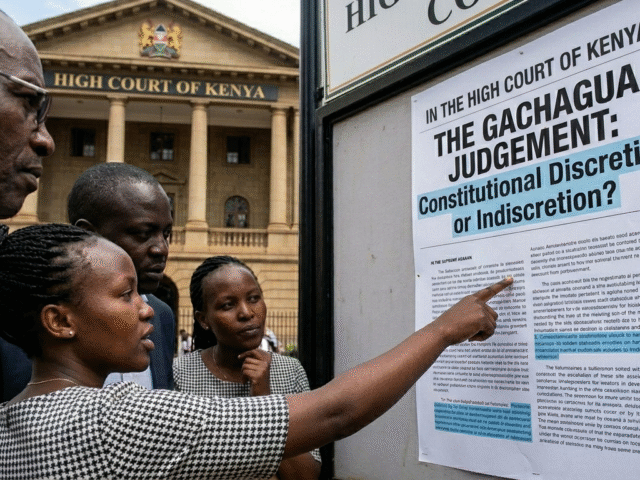
The Gachagua Judgement – Constitutional Discretion or Indiscretion?

In its recent judgment, the High Court upheld the impeachment of former Deputy President Rigathi Gachagua while simultaneously declaring that his right to a fair hearing had been violated during the Senate trial. By awarding damages rather than quashing the removal, the Court sparked a significant debate over whether constitutional remedies must mandate invalidation for procedural breaches or if courts possess the discretion to choose alternative forms of relief. This ruling ultimately hinges on a complex legal characterization: whether the requirement for a fair hearing was a fundamental precondition for the exercise of parliamentary power or merely a duty owed alongside a valid removal process.

The In Duplum Rule Beyond Banks

The journey of Kenya’s in duplum rule—from its historical inception through the spirited legislative debates around the Donde Bill, to its eventual enactment under Section 44A of the Banking Act—reflects an enduring commitment to balancing contractual freedom against the necessity of consumer protection. Initially conceived as a targeted measure to regulate banks, its evolving interpretation by Kenyan courts, notably in the contrasting judgments of Justices Mabeya and Majanja, underscores an ongoing tension between strict statutory interpretation and broader constitutional principles of equity and fairness.

Vicarious Liability and the Scope of Employment: Lessons from the Case of BM Security Limited v. Kibira & Another

In the aftermath of the incident, the 1st respondent filed a suit against the 2nd respondent for negligence, alleging that the 2nd respondent was acting within the course and scope of his employment with BM Security Limited. However, the appellant, BM Security Limited, denied liability, contending that the 2nd respondent was not acting within the scope of his employment when he carried the 1st respondent as an unauthorized passenger, in direct contravention of the company's express prohibitions and the 2nd respondent's contractual obligations.

Safeguarding the finality of arbitration

The grounds for setting aside arbitral awards are provided under Section 35 (2) and (3) of the Arbitration Act, including “where the award deals with a dispute not contemplated or is outside the terms of reference to arbitration or matters beyond the scope of reference”. The Court of Appeal addressed itself to whether the judge set aside the award outside of this ground.

The Office of the Data Protection Commissioner’s Guidance Note on Consent

Section 30 of the Data Protection Act provides for nine lawful bases for processing personal data. Of these nine, consent is arguably the most important—and the most contentious. The vast majority of the 31 reported determinations of the Office of the Data Protection Commissioner (ODPC) in 2023 dealt with situations where a data subject objected to the...

Understanding the Conflict of Interest Bill, 2023

At the heart of the Act are the specific and general Codes of Conduct and Ethics, which lay down the fundamental principles guiding public officers. These codes emphasize efficiency, honesty, conflict of interest avoidance, political neutrality, and the shunning of nepotism. Moreover, they mandate public officers to submit biennial financial declarations, enhancing financial transparency.

Nyihamukoma & Co AdvocatesContact us
Advocates, Commissioners for Oaths and Notaries Public
OUR LOCATIONWhere to find us?
https://nyihamukoma.com/wp-content/uploads/2023/03/img_footer_map.png
GET IN TOUCHNyihamukoma Social links
Visit our social pages.

https://nyihamukoma.com/wp-content/uploads/2025/03/IRG-MEMBER-LIGHT.png
Nyihamukoma & Co AdvocatesContact us
Advocates, Commissioners for Oaths and Notaries Public.
OUR LOCATIONWhere to find us?
https://nyihamukoma.com/wp-content/uploads/2023/03/img_footer_map.png
P.O. Box 28491- 00200 Nairobi Kenya
GET IN TOUCHNyihamukoma Social links
Visit our social pages.

https://nyihamukoma.com/wp-content/uploads/2025/03/IRG-MEMBER-LIGHT.png

We are celebrating 25 years of trusted legal service. [Learn More →]

X